-
About Us
-
-
-
Contact Us
Concrete Support — Black King Kong Report
In mining engineering and various underground construction projects, the selection and design of support structures are crucial to the safety and stability of the project. Concrete support, as an important form of support, plays a key role in maintaining underground spaces due to its continuous and integral characteristics. It acts like a sturdy armor for underground tunnels, not only sealing the surrounding rock to effectively prevent contact with external air and moisture, thereby preventing weathering and extending its service life, but also resisting various pressures from the surrounding rock through its structural features.
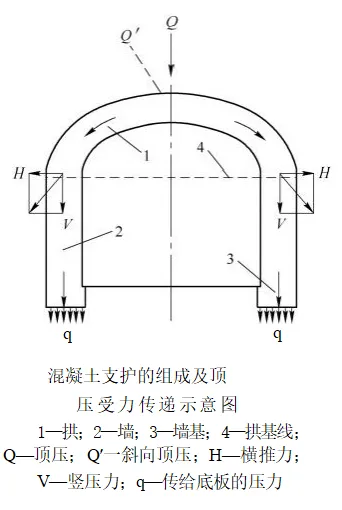
The main form of concrete support is the straight wall arch, an organic combination of the arch, wall, and wall base. The arch, as the critical top part of the entire support structure, acts like a strong dome, mainly bearing the top pressure and cleverly transferring this load to the side walls and both sides. Generally, the arch sections mainly endure compressive stress and some bending stress, fully utilizing concrete's high compressive strength. However, when the top pressure is uneven or asymmetrical, shear stress may also appear within the section. The thickness of the arch is not arbitrarily determined; it is influenced by multiple factors such as tunnel span and arch height. The larger the span and the higher the arch, the greater the pressure it must bear, thus requiring increased thickness. The rock properties are also crucial; hard rock provides better support for the arch, allowing for a thinner arch, while soft rock requires a thicker arch to ensure safety. Concrete strength is another factor determining arch thickness; higher strength allows for relatively thinner arches. In practice, arch thickness can be calculated using empirical formulas, but more often it is selected from tables to ensure accuracy and reliability. The wall plays an indispensable role in supporting and resisting lateral pressure in the concrete support structure. Usually, the wall is straight, which facilitates construction and meets most engineering needs. However, when lateral pressure is large, the straight wall is modified into a curved wall to better resist lateral forces. At the arch base, the load transferred from the arch to the wall is oblique, generating horizontal thrust. If the concrete at the arch base is not densely filled with the surrounding rock, the arch and wall under horizontal thrust act like a building with an unstable foundation, easily deforming and losing stability. Wall thickness is closely related to arch thickness; generally, the wall thickness is greater than or equal to the arch thickness, usually equal, ensuring coordinated stress bearing between wall and arch to jointly withstand pressure from the surrounding rock. The wall base is the connection between the entire support structure and the floor slab, transmitting the load from the wall and its own weight evenly to the floor slab. When the floor rock is hard, the wall base can be an extension of the straight wall, simply and directly transferring the force downward. However, when the floor rock is soft, the wall base must be widened to increase the bearing area and reduce pressure per unit area. If floor heaving occurs, a bottom arch must be built to enhance support and restraint of the floor slab. The depth of the wall base is strictly required to be no less than the wall thickness to ensure stability. The wall base depth on the side adjacent to the drainage ditch is generally the same as the ditch floor, but when the floor rock is soft and fragmented, the wall base must be 150-200mm deeper than the ditch floor to ensure stability under complex geological conditions. When a bottom arch is used, its rise is generally 1/8 to 1/6 of the top arch rise, and its thickness is 50%-80% of the top arch thickness. These ratios are derived from extensive engineering practice and theoretical research, enabling the bottom arch to be economically reasonable while ensuring structural stability.
Applicable Conditions Concrete support has specific applicable scenarios in underground engineering, chosen based on comprehensive considerations of safety, stability, and economic rationality.
• Surrounding rock is highly fractured When the surrounding rock is highly fractured, the advantages of shotcrete and anchor support are no longer significant. Because fractured rock cannot provide a sufficiently stable anchoring base for bolts, the bolts cannot effectively perform their suspension and reinforcement functions, much like inserting sticks into loose sand where they cannot be fixed. Shotcrete also struggles to form effective adhesion and sealing on fractured surfaces, failing to prevent further loosening and collapse of the surrounding rock. At this time, concrete support, with its continuous and integral structure, can provide comprehensive support and sealing for fractured surrounding rock, effectively preventing weathering and further fracturing, maintaining tunnel stability.
• Surrounding rock is highly unstable In cases where the surrounding rock is highly unstable and the roof rock is prone to collapse, shotcrete often cannot be sprayed or adhere firmly. Due to the poor condition of the roof, concrete cannot bond effectively with it, making it difficult to form a support structure. Additionally, such unstable surrounding rock is not conducive to drilling holes for bolt installation, as drilling may trigger further roof collapse, increasing construction risks. Concrete support can, during construction, use formwork to cast concrete into an integral structure, directly supporting the unstable surrounding rock without relying on drilling and bonding operations that are difficult under these conditions, providing reliable protection for the tunnel.
• Areas with large-scale water seepage or ineffective partial water inflow treatment In areas with large-scale water seepage or ineffective partial water inflow treatment, prolonged water action softens the surrounding rock, reducing its strength and stability. For shotcrete and anchor support, water affects the setting and strength development of sprayed concrete, causing the sprayed layer to easily fall off; it also reduces the anchoring force of bolts, making it ineffective in supporting the surrounding rock. Concrete support has good waterproof performance, blocking water erosion of the surrounding rock. Its continuous structure can better withstand additional pressure caused by water action, ensuring tunnel safety and stability in humid environments.
• Tunnels with long service life For tunnels with long service life, a support method capable of maintaining stability and support performance over time is required. Concrete support has high strength and durability, able to withstand surrounding rock pressure for extended periods without damage from time and environmental factors. Compared to other support methods, such as wooden supports prone to decay and metal supports susceptible to corrosion and strength reduction, concrete support is more suitable for long-term use, reducing maintenance and replacement costs and workload, ensuring normal tunnel use throughout its service life.
Formwork and Templates During the construction process of concrete supports in flat tunnels, formwork and templates are indispensable important tools. They act like the "molds" and "supporting frameworks" of concrete, providing the necessary conditions for the shaping and curing of concrete. The formwork mainly bears the weight of the concrete, the load of the workbench, and impact loads during construction, while the template is in direct contact with the concrete and determines the shape and size of the concrete support structure. To respond to the concept of sustainable development, save wood resources, and improve material reuse rates, metal formwork and templates are commonly used in actual projects. Metal materials have the characteristics of high strength and good durability, can be reused multiple times, greatly reducing construction costs and the consumption of wood resources. However, for some special chambers and intersections, due to their complex structure and irregular shape, wood formwork and templates are still partially used. Wood formwork and templates have the advantages of easy processing and high flexibility, allowing customization and adjustment according to special construction needs, better adapting to complex construction environments.
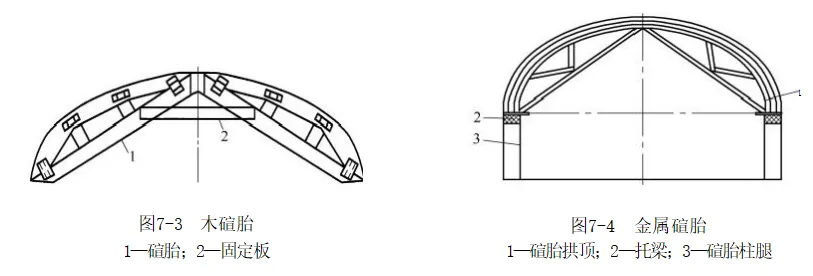
As an important supporting structure in the concrete construction process, formwork must have certain strength and stiffness to ensure that it does not deform or get damaged under various loads, thereby guaranteeing the quality of concrete pouring and construction safety. In practice, the structural form and component sizes of formwork are generally selected based on experience. Wooden formwork is usually made of square timber or 2-3 layers of plywood, and for ease of transportation and installation, it is usually assembled in 2-3 sections. Metal formwork is generally made of No. 14-18 channel steel or 15-24 kg/m rails, with a more robust structure capable of bearing greater loads. The materials for making templates also have various options, generally made of No. 8-10 channel steel or 30-40mm thick wooden boards. Metal templates should be preferred during construction due to their high strength, resistance to deformation, ease of repair, and high reuse rate. Mining plastic templates have also gradually been promoted in recent years; they are lightweight, easy to demold, quick to assemble and disassemble, corrosion-resistant, have a long service life, and can be reused 30-40 times. In tunnels or shafts, these advantages of mining plastic templates can effectively improve construction efficiency, reduce construction costs, and minimize environmental impact.
Concrete support plays an important role in underground engineering due to its unique structural characteristics. The straight wall arch structure, with the arch, wall, and wall base each performing their respective functions, jointly resists the surrounding rock pressure. Its continuous and integral nature effectively encloses the surrounding rock and prevents weathering. Although the construction process is complex, the duration is long, and the cost is high, in specific scenarios such as fractured and unstable surrounding rock, ineffective water inflow treatment, and long service life requirements, concrete support, with its stability and durability, becomes a reliable choice to ensure engineering safety. Formwork and templates, as auxiliary construction tools, come in various forms.