-
About Us
-
-
-
Contact Us

Detailed Explanation of Ground Pressure Management (Part 2): Factors Affecting the Self-Supporting Capacity of Mine Rock, Calculation Methods for Pillar Sizes in Horizontal and Gentle Inclined Ore Bodies, Discussion on Pillar Calculation Methods for Steeply Inclined Ore Bodies — Black Diamond Report
In mining engineering, ground pressure management is a crucial task directly related to the safety and stability of the mine. This article, as the second part, will explore this method in depth from multiple perspectives and analyze the methods for determining pillar parameters, especially the shape, size, and calculation methods of pillars, aiming to provide useful references for mine ground pressure management.
1. Factors Affecting the Stability of Exposed Surfaces by Utilizing the Self-Supporting Capacity of Ore Rock
Using the self-supporting capacity of ore rock to maintain the stability of exposed surfaces is an important means of mine ground pressure management. To achieve this goal, it is necessary to fully understand and control multiple influencing factors to ensure that the span or area of the mining space does not exceed the limit values. The following are several main influencing factors:
Physical and Mechanical Properties of Ore Rock
The physical and mechanical properties of ore rock are key factors determining its self-supporting capacity. Among them, stability is one of the most important properties, determining the maximum exposed area of ore rock without support. Based on the stability of ore rock, it can be classified into extremely unstable, unstable, moderately stable, and stable categories. These classifications provide engineers with a basis for selecting support measures and designing the size of mining spaces.
Extremely Unstable Ore Rock This type of ore rock has very poor self-supporting capacity and requires strong support measures; otherwise, accidents such as roof falls and rib spalling are likely to occur.
Unstable Ore Rock Although it has some self-supporting capacity, support must be set at appropriate locations to reduce the exposed area and exposure time.
Moderately Stable Ore Rock In most cases, the stability of the exposed surface can be maintained by the ore rock's self-supporting capacity, but support is still needed under specific conditions.
Stable Ore Rock This type of ore rock has strong self-supporting capacity and usually does not require additional support measures, but regular inspection and monitoring are still necessary to ensure safety.
The stability of ore rock is influenced by various factors such as geological structure, degree of joint and fracture development, and lithological composition. Therefore, detailed investigation and testing of ore rock should be conducted before mining to accurately assess its stability.
Mining Depth
Mining depth is another important factor affecting the self-supporting capacity of ore rock. As mining depth increases, the self-weight stress on the ore rock increases, leading to a decrease in its self-supporting capacity. Additionally, increased mining depth exacerbates deformation and damage to the rock mass, worsening the stability of the exposed surface.
The calculation of self-weight stress needs to consider the weight of the overlying rock layers and the density of the rock. It should be noted that the depth here does not refer to the vertical distance from the surface to the mining point but to the height of the overlying rock layers. Therefore, geological structure and rock layer distribution must be fully considered when calculating mining depth.
Height of Overlying Rock Layers Above the Roof of the Mining Space
The height of the overlying rock layers above the roof of the mining space is also an important factor affecting the self-supporting capacity of ore rock. As the height of the overlying rock layers increases, the load on the roof increases, reducing its bearing capacity. Moreover, the height of the overlying rock layers affects the deformation and failure modes of the roof, thereby influencing the stability of the exposed surface.
When calculating the height of the overlying rock layers, multiple factors need to be considered, such as the physical and mechanical properties of the rock layers, the degree of joint and fracture development, and the effect of groundwater. By comprehensively analyzing these factors, the effective height of the overlying rock layers acting on the mining space can be determined, providing a basis for the reasonable design of the mining space.
Duration of Exposure of the Exposed Surface
The duration of exposure of the exposed surface also has an important impact on its stability. As the exposure time increases, the creep effect of the rock mass gradually appears, leading to a reduction in the bearing capacity of the exposed surface. This effect is especially significant for soft rock, which requires appropriate support measures to reduce exposure time and ensure the stability of the exposed surface.
In actual mining operations, the work sequence and time intervals should be reasonably arranged to reduce the exposure time of the exposed surface. At the same time, regular inspection and monitoring of the exposed surface are necessary to promptly identify and address potential safety hazards.
Geometric Shape of the Exposed Surface
The geometric shape of the exposed surface is also an important factor affecting its stability. In mining engineering, the shapes of mining units vary, including rectangles, long rectangles, squares, and other irregular polygons. These different shapes of exposed surfaces have differences in stress characteristics and stability.
Taking rectangles and squares as examples, their stability is affected by the length-to-width ratio. When the length-to-width ratio of the exposed area is greater than 2, stability is generally related to the width of the exposed surface; when the ratio is less than 2, stability is related to the exposed area. Therefore, when designing mining spaces, factors such as the geometric shape and length-to-width ratio of the exposed surface should be fully considered to ensure stability.
2. Methods for Determining Pillar Parameters
Pillars play a key role in supporting the roof of the mining face. To ensure that pillars can effectively bear loads and maintain the stability of the exposed surface, their parameters must be reasonably determined. The following are the main methods for determining pillar parameters:
Effect of Pillar Shape on Its Bearing Capacity and Strength
The shape of the pillar directly affects its bearing capacity and strength. Generally, the larger the width-to-height ratio of the pillar (i.e., larger area but smaller height), the higher its strength. This is because increasing the width of the pillar enhances its ability to resist deformation and failure, thereby improving its bearing capacity. Conversely, if the pillar is too tall and narrow, its stress state becomes unfavorable and prone to failure.
In actual engineering, some measures are usually taken to optimize the shape of pillars. For example, by adjusting the mining sequence and extraction method, the shape and size of pillars can be controlled to better conform to mechanical principles. Additionally, filling techniques can be used to change the stress state around the pillars, thereby improving their bearing capacity.
Methods for Determining Pillar Size
The size of the pillar is one of the key factors affecting its bearing capacity. When determining the size of pillars, multiple factors need to be comprehensively considered, including the physical and mechanical properties of ore rock, mining depth, height of overlying rock layers, duration of exposure of the exposed surface, and the geometric shape of the exposed surface.
For the calculation of pillar dimensions in horizontal and gently inclined ore bodies, a relatively simple method can be used. Since the stress state of such pillars is similar to that of columns in buildings, the dimensions can be determined based on the weight of the overlying rock strata above and the bearing capacity of the pillar itself. During the calculation process, factors such as the cross-sectional area of the pillar, the area of the overlying rock strata, load factors, and safety factors need to be considered. Through reasonable calculation and analysis, pillar dimensions that meet the requirements can be obtained.
However, for the calculation of pillar dimensions in steeply inclined ore bodies, the problem is much more complex. Due to the special mining conditions of steeply inclined ore bodies, pillars are often subjected to both shear stress and bending stress, which reduces their bearing capacity. Therefore, more complex methods need to be used when calculating the pillar dimensions for steeply inclined ore bodies. Usually, factors such as the bearing capacity of inter-pillar areas, the stressed area, and the weight of the overlying rock strata need to be considered. In addition, numerical analysis software is often used for simulation calculations to obtain more accurate pillar dimensions.
In practical engineering, to ensure the stability and safety of pillars, additional measures are usually taken. For example, support structures are set around the pillars to enhance their bearing capacity; grouting and other methods are used to improve the mechanical properties of the pillars; and regular inspections and monitoring of the pillars are conducted. These measures can effectively improve the stability and safety of the pillars, ensuring the smooth progress of mining production.
3. Calculation Method for Pillar Dimensions in Horizontal and Gently Inclined Ore Bodies
The calculation of pillar dimensions for horizontal and gently inclined ore bodies can be carried out using the following steps:
Determine the Weight of the Overlying Rock Strata
First, the weight of the overlying rock strata needs to be determined. This can be calculated by measuring the height of the overlying rock strata and the density of the rock. During the calculation process, attention should be paid to the influence of the physical and mechanical properties of the rock strata and the development degree of joints and fractures on the weight.
Calculate the Cross-Sectional Area of the Pillar
Next, the cross-sectional area of the pillar needs to be calculated. This can be determined based on the shape and size of the pillar. In practical engineering, the shape of the pillar may vary due to different mining conditions and design requirements. Therefore, when calculating the cross-sectional area, the actual shape and size of the pillar must be fully considered.
Determine Load Factor and Safety Factor
The load factor is a coefficient used to consider additional loads and uncertainties. It can be determined based on engineering experience and actual conditions. The safety factor is a coefficient used to ensure the safety of the pillar. It is usually determined based on the physical and mechanical properties of the ore rock and mining conditions. When determining these two factors, actual conditions and engineering requirements must be fully considered.
Calculate Pillar Dimensions
For pillars in horizontal and gently inclined ore bodies, this calculation is relatively easy. Because these pillars are similar to columns in a building's main hall, the principle is the same. That is, the bearing capacity or size of each pillar is determined by the height or weight of the overlying rock strata above the pillar. Therefore, we can calculate according to this formula.
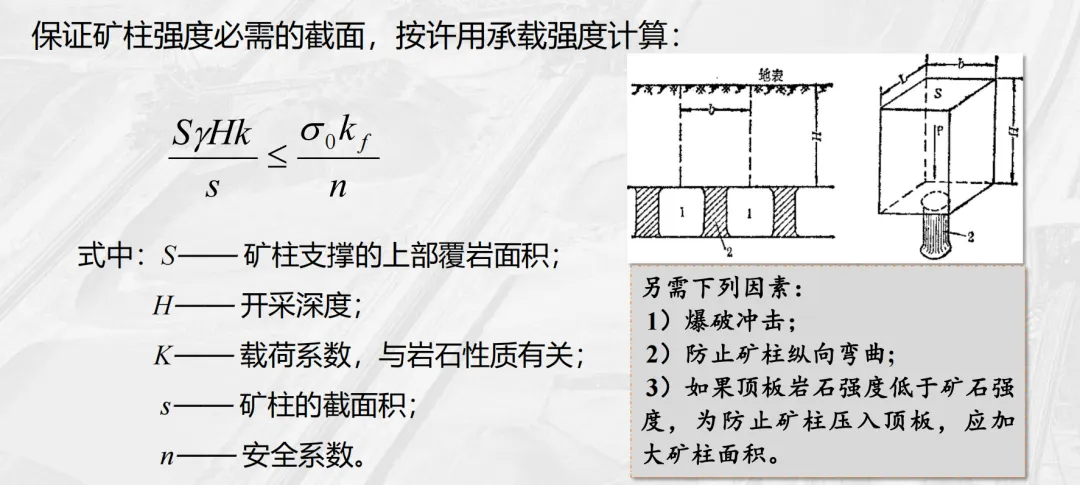
Analyzing this formula, it can be seen that the numerator of the denominator is actually the overlying weight, while the denominator is the area of the pillar. Compared to the pillar itself, the strength obtained from the overlying rock strata is less than its allowable strength, which is the allowable bearing capacity of the pillar rock itself. A certain safety factor is also considered. This way, the pillar dimensions can be simply calculated.
As you can see, in the formula, S in the numerator is the area of the overlying rock supported by the pillar, H is the mining depth, K is the load factor, s in the denominator is the cross-sectional area of the pillar, and N is the safety factor. However, as mentioned earlier, this is a simple calculation. In practice, it cannot be so simply calculated based on mining depth alone, because the weight of the rock covered by the mining depth is not equal to the weight of the rock strata above the pillar. This applies to the calculation of horizontal or gently inclined pillars.
It should be noted that the above method is only applicable to the calculation of pillar dimensions in horizontal and gently inclined ore bodies. For the calculation of pillar dimensions in steeply inclined ore bodies, due to the more complex stress state, more complex methods need to be used.
4. Discussion on the Calculation Method for Pillars in Steeply Inclined Ore Bodies
The calculation method for pillars in steeply inclined ore bodies is relatively complex because pillars are often subjected to both shear stress and bending stress during mining. The following is a discussion on the calculation methods for pillars in steeply inclined ore bodies:
Consider the Bearing Capacity of Inter-Pillars
For steeply inclined ore bodies, inter-pillars are continuous pillars with relatively good bearing capacity. Therefore, when calculating the pillar dimensions for steeply inclined ore bodies, the bearing capacity of inter-pillars must be fully considered. This can be obtained through mechanical analysis and calculation of the inter-pillars to determine their bearing capacity range.
Use Numerical Analysis Software for Simulation Calculations
Due to the special and complex mining conditions of steeply inclined ore bodies, it is difficult to calculate pillar dimensions using simple formulas. To obtain more accurate calculation results, numerical analysis software can be used for simulation calculations. This can be done by establishing a numerical model of the mine to simulate the stress state and deformation during the mining process, thereby obtaining pillar dimensions that conform to actual conditions.
Consider the Influence of Multiple Factors
When calculating pillar dimensions for steeply inclined ore bodies, multiple factors need to be comprehensively considered. These include the physical and mechanical properties of the ore rock, mining depth, height of the overlying rock strata, exposure duration of the exposed surface, and the geometric shape of the exposed surface. By fully considering the influence of these factors, more accurate and reliable pillar dimension calculation results can be obtained.
Take Additional Support Measures
To ensure the stability and safety of pillars in steeply inclined ore bodies, additional support measures are usually required. For example, support structures are set around the pillars to enhance their bearing capacity; grouting and other methods are used to improve the mechanical properties of the pillars; and techniques such as pre-splitting blasting are employed to reduce stress concentration during mining. These measures can effectively improve the stability and safety of the pillars.
In practical engineering, the calculation and determination of pillar dimensions in steeply inclined ore bodies often require comprehensive consideration of multiple factors and the use of various methods for analysis and verification. For example, more accurate data and parameters can be obtained through field monitoring and testing; advanced testing technologies and equipment can be used for more in-depth research and analysis of the physical and mechanical properties of the ore rock; and advanced experiences and achievements in related fields at home and abroad can be referenced to optimize calculation methods and improve calculation accuracy.
In summary, in mining engineering, managing ground pressure by utilizing the self-supporting capacity of the ore rock and reasonably determining the parameters of the mine pillars is a crucial task. This not only ensures the safety and stability of the mine but also improves mining efficiency and economic benefits. Therefore, in practical engineering, it is necessary to fully consider the influence of various factors and adopt scientific and reasonable methods for calculation and analysis to ensure the rationality and reliability of the pillar dimensions. At the same time, on-site monitoring and testing work need to be strengthened to promptly identify problems and take corresponding measures for handling and improvement, ensuring the smooth operation and sustainable development of mine production.
Furthermore, with continuous technological advancement and the ongoing development of mining technology, there may be more innovations and improvements in the future regarding pillar dimension calculation and ground pressure management. For example, more advanced numerical analysis software and simulation technologies can be used to more accurately predict and analyze the stress state and deformation conditions of the mine; more intelligent monitoring systems and sensors can be employed to monitor the stability and safety of the pillars in real time; and more efficient and environmentally friendly mining technologies and equipment can be developed to reduce sensitivity and impact on ground pressure, among other possibilities.