

-
About Us
-
-
-
Contact Us

Progressive Mining: Roadway Layout and Technical Practices for Retaining Roadways Along Gob Areas — Hejingang Broadcast
Progressive Mining: Roadway Layout and Technical Practices for Retaining Roadways Along Gob Areas
Analysis of Diverse Alleyway Layout Methods
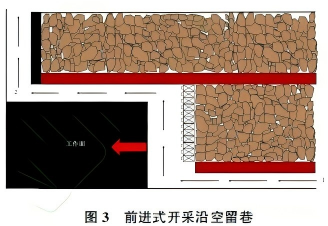
In advancing longwall mining, the spatial relationship between the retreat roadway and the coal mining face determines four typical layout configurations. The single-lane advanced pre-excavation layout involves pre-driving the retreat roadway ahead of the working face, using the shearer to directly cut through the roadway cross-section—thus creating a dedicated passage in advance to facilitate face advancement. In contrast, the single-lane no-preexcavation layout breaks away from conventional pre-excavation practices, enabling simultaneous construction of the retreat roadway and the coal mining face, thereby achieving integrated mining and excavation operations and significantly reducing project timelines. The dual-lane fully no-preexcavation approach also employs a synchronized advancement strategy, with the shearer cutting both lanes simultaneously to form their cross-sections, boosting roadway excavation efficiency. Meanwhile, the dual-lane advanced pre-excavation method entails constructing two parallel roadways ahead of the working face in advance, providing an additional layer of safety and reliability for subsequent mining activities. These layout strategies have been successfully implemented at the 3102 working face of Tianyi Coal Industry Company under Jingkuang Group, where continuous optimization of support techniques has ensured the safe and efficient progression of advancing longwall mining operations.
Key Support Technologies and Theoretical Foundations
The support design for gob-side entry retaining is a core technical component of advancing mining, encompassing three key aspects: basic support, reinforced support, and side-entry support. Its theoretical foundation stems from the stress calculation formula for fractured roof strata, which indicates that the pressure on the working face supports is directly proportional to the width of the roof control zone. Taking the No. 3 coal seam as an example, practical on-site assessments combined with theoretical calculations have determined a reasonable roof control zone width of 3.6 to 4.0 meters. This approach not only meets the operational needs for ventilation, transportation, and other production requirements but also effectively controls support intensity, providing a scientific basis for ensuring long-term stability of the roadway.
Stress Evolution and Deformation Control in Retreating Mining with Goaf-Remaining Roadway
Analysis of Stress Variation Stage Characteristics
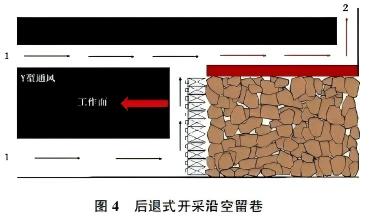
In the early stages of retreat mining, the working face is relatively far from the roadway, meaning the surrounding rock mass experiences relatively stable stress conditions, and excavation activities have minimal impact on it. As mining progresses into the secondary recovery phase following the retention of the roadway, the mining-induced stresses near the working face gradually propagate toward the roadway, disrupting the original stress equilibrium in the surrounding rock and causing a redistribution of stresses. During this stress redistribution process, stress concentration zones around the roadway progressively expand, further intensifying deformation. By the later stages of mining, as the working face approaches the intersection between the working face and the roadway, the roadway enters a zone of concentrated stress, bearing the combined pressure exerted by the overlying roof coal, the self-weight of the immediate roof, and the rotational forces generated by the basic roof above the mined-out area—resulting in complex multi-directional stress interactions. This intricate stress environment significantly increases the pressure on the roadway, leading to substantial increases in both the convergence deformation of the sidewalls and the vertical displacement of the roof and floor. Such changes pose a severe threat to the long-term stability of the roadway. For instance, in mining operations at a particular coal mine, when the working face advanced to within a certain distance of the roadway, the roof and floor displacement rapidly escalated within a short period, while sidewall convergence deformation also exceeded expectations, severely compromising the normal functionality of the roadway.
Deformation Patterns and Engineering Responses
Through statistical analysis of monitoring data from multiple coal mines employing the retreat mining method with gob-side entry retaining, it has been found that roadway deformation follows a distinct pattern. During the secondary mining stage, the deformation rate gradually accelerates, reaching its peak near the intersection between the working face and the roadway boundary. In response to this deformation trend, engineering practices must implement a series of effective control measures. Specifically, in terms of side-entry support, high-strength support structures—such as hydraulic supports and high-water material-filled backfill—are employed to significantly enhance the load-bearing capacity of the side entries, effectively distributing mining-induced stresses and minimizing roadway deformation. Optimizing roadway support parameters is also crucial; for instance, combining high-strength bolts with cable bolting not only increases the length and density of these elements but also boosts the anchoring force within the surrounding rock, thereby strengthening the overall rigidity of the surrounding rock mass and curbing deformation progression. As demonstrated by relevant projects undertaken by Huainan Mining Group, optimizing support parameters and adopting high-strength bolt-cable systems have markedly improved the stability of roadway surrounding rock, effectively controlling deformation. Meanwhile, by integrating real-time monitoring data from on-site sensors—such as stress sensors and displacement monitors—engineers can continuously track stress changes and deformation dynamics, enabling timely adjustments to the support strategy, including reinforcing support intensity or modifying support methods, thus ensuring the long-term stability of roadways even under complex stress conditions.
The advantages of the hybrid model for longwall mining with gob-side entry retaining, and the technical features of continuous versus reciprocating mining methods.
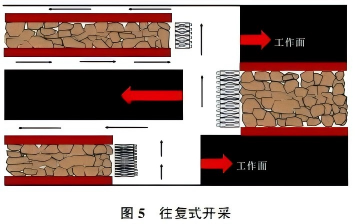
Reciprocating mining, as an organic combination of advancing and retreating methods, offers unique operational advantages. After the previous coal face advances to the final mining line, the equipment in the upper and lower sections within the mining area is either lifted or lowered, enabling a continuous, back-and-forth mining pattern—alternating between forward and backward movements. This approach breaks the limitations of a single mining direction, making full use of existing roadways and equipment while minimizing the need for frequent equipment relocation, thereby enhancing mining efficiency. At the same time, it sidesteps the constraints inherent in conventional mining methods regarding roadway layout and stress management, ultimately achieving both efficient resource recovery and uninterrupted production. In the application at the Kangcheng Mine of Handan Mining Group, the reciprocating mining technology has successfully enabled continuous pillar-free face mining within the mining area, effectively addressing the challenges of tight mining operations in aging mines and significantly improving resource recovery rates. This innovative approach has provided valuable practical experience for similar mines, offering a promising model for future development.
Key Points for Engineering Applications
The successful implementation of reciprocating mining relies on precise equipment scheduling and advanced roadway maintenance techniques. In terms of equipment management, it is essential to ensure rapid relocation and reliable operation of equipment across upper and lower sections, thereby minimizing production preparation time. Meanwhile, roadway maintenance poses unique challenges due to the frequent changes in mining direction, which cause fluctuations in both the direction and magnitude of mining-induced stresses acting on the roadway. To address this, a composite support system combining flexible and rigid support elements has been adopted, effectively adapting to stress variations during the reciprocating mining process and ensuring the stability and safety of the roadway throughout its various stages. For instance, at a specific reciprocating longwall face in Guandi Mine, Xishan Coal & Electricity of Shanxi Coking Coal Group, an effective roadway stabilization strategy was implemented. This involved reinforcing the roadway with a combined anchor-net-anchor-cable support system, along with the construction of concrete walls near the goaf area and the installation of advanced support measures 20 meters ahead of the working face. Long-term monitoring of mine pressure clearly demonstrated that this support approach delivered outstanding results, maintaining the integrity of the surrounding rock mass during the mining process and providing robust support for the application of reciprocating mining technology in complex geological conditions.
Classification, Application, and Material Innovation in Filling-Style Mining for Goaf Retaining巷
Classification and Feature Comparison of Filling Technologies
Depending on the construction materials and techniques used, filled-in gob-side entry retaining methods can be categorized into several types. Metal pillar-supported gob-side entry retaining utilizes the high strength of metal pillars to provide robust support along the side of the roadway, making it ideal for scenarios with significant roof pressure. In contrast, timber-stack wall–based gob-side entry retaining employs wooden timbers stacked together to form a flexible yet supportive wall structure; however, this method offers relatively poor fire resistance and durability. Meanwhile, high-water-material-filled gob-side entry retaining represents an innovative approach, using low-grade calcium sulfoaluminate cement clinker as its primary ingredient. By carefully adjusting the mix proportions, incorporating appropriate admixtures, and precisely controlling parameters such as water-cement ratio and water temperature, this technique significantly enhances both the early strength and overall stability of the filling material. As a result, it boasts advantages like convenient construction and excellent support performance, leading to its increasingly widespread adoption in practical engineering projects.
Practice of High-Water Material Filling Technology
Research by Chen Zhisong and others indicates that the physical and mechanical properties of high-water materials are significantly influenced by factors such as admixture dosage, water-cement ratio, and water temperature. By optimizing these parameters, it is possible to effectively enhance the strength and durability of the backfill material. Field applications have demonstrated that using high-water-based backfill in gob-side entry retaining巷道 exhibits minimal deformation, successfully controlling surrounding rock movement and providing robust support for safe mine operations. This technology not only reduces coal pillar losses and boosts resource recovery rates but also enables environmentally friendly mining practices, delivering both substantial economic and environmental benefits.
Summary
Different mining methods for gob-side entry retaining technology each have their own unique characteristics. The advancing method emphasizes the flexibility of roadway layout and precise control over support strength, while the retreating method requires addressing the complex stress conditions that emerge in later stages. The reciprocating method enables continuous, highly efficient production, and the filling method continues to innovate in both materials and processes.
